 Frontier Eye Desk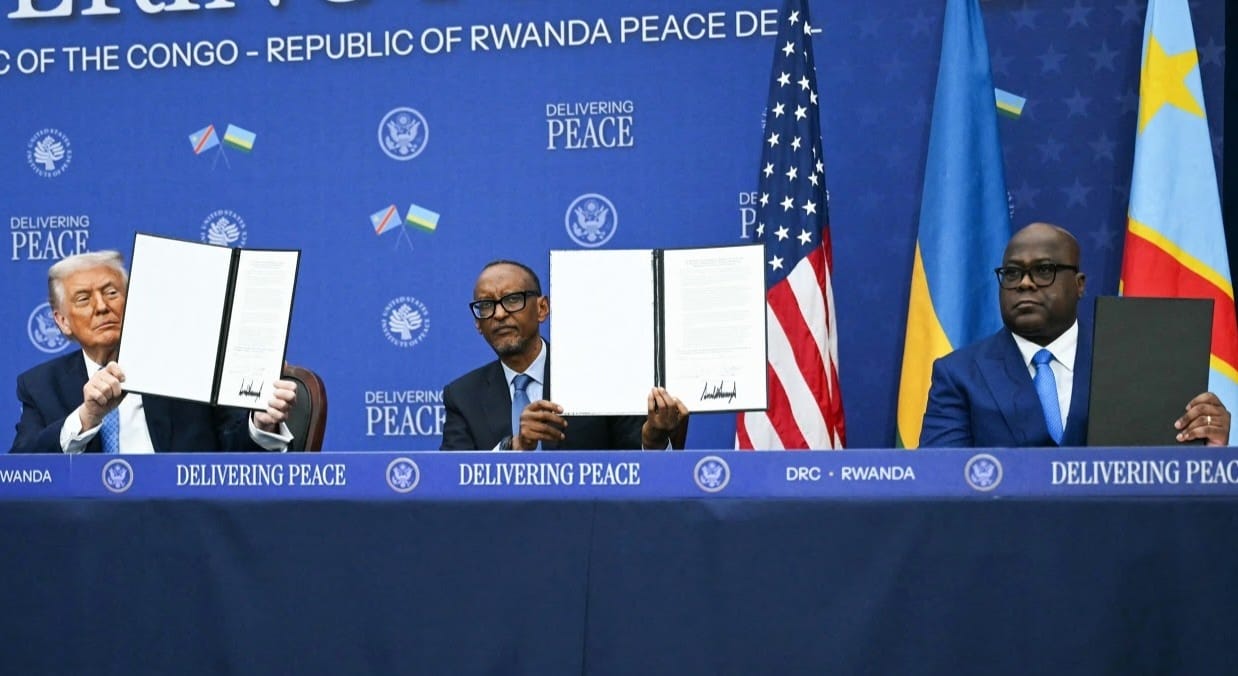
Washington, D.C.
Presidents Felix Tshisekedi of the Democratic Republic of the Congo (DRC) and Paul Kagame of Rwanda on December 4 signed the Washington Accords, reaffirming their commitment to a U.S.-brokered framework aimed at ending decades of violence in eastern DRC. The ceremony, hosted by U.S. President Donald J. Trump at the U.S. Institute of Peace, marked a significant milestone in efforts to stabilize the Great Lakes region.
The accords consolidate earlier understandings—including the April 25 Declaration of Principles and the June 27 Peace Agreement—into the Washington Accords for Peace and Prosperity. The framework commits both countries to mutual respect, withdrawal of foreign forces, disarmament of armed groups, and deeper economic cooperation under the Regional Economic Integration Framework (REIF). The joint declaration, signed in English and French, expresses confidence that the accords provide “a strong foundation for mutual respect and the advancement of peace in the region.”
U.S. President Donald J. Trump hosted and witnessed the signing alongside Secretary of State Marco Rubio and Vice President JD Vance. Several African leaders attended as regional guarantors and witnesses, including Kenyan President William Ruto, Angolan President João Lourenço, Burundian President Évariste Ndayishimiye, Togolese President Faure Gnassingbé, and Uganda’s Vice President Jessica Alupo.
President Ruto, who arrived in Washington on December 3, hailed the accord as a “monumental diplomatic milestone” and a “credible and hopeful pathway” toward lasting peace in eastern Congo. He reaffirmed Kenya’s commitment to regional stability and underscored its central role in East African Community mediation efforts and support for the Nairobi Process, which runs parallel to the U.S.-led talks.
President Trump called the signing a “glorious triumph” that addresses a conflict spanning more than 30 years, crediting “intensive diplomacy” for bringing the parties together. Kagame described Trump as “even-handed” and praised the process for offering “the clearest and most viable path forward.” Tshisekedi voiced “deep gratitude and clear hope,” urging Rwanda to uphold both the letter and spirit of the agreement.
The event also drew international observers, including the foreign ministers of Qatar and the United Arab Emirates, underscoring broad diplomatic support for the initiative. In parallel, the DRC is preparing to sign a new economic partnership with the United States, highlighting the accords’ focus on harnessing the region’s vast reserves of cobalt, copper, lithium, and coltan for shared prosperity.
Yet even as leaders gathered in Washington, fighting raged in eastern Democratic Republic of Congo on Friday—just one day after the accords were signed. Clashes in a region rich in minerals underscored both the urgency and fragility of the commitments made.
The renewed violence, concentrated in South Kivu, involves ongoing clashes between the Congolese army and the Rwanda-backed M23 rebel group. Rwanda denies supporting M23, insisting its regional posture is driven by threats from armed groups such as the FDLR, whose ranks include remnants of the 1994 genocide perpetrators.
Congo maintains that Rwanda uses the insurgency to access its mineral wealth, a claim echoed in multiple UN reports. Progress on the peace process continues to hinge on stalled negotiations between Kinshasa and M23 despite sustained U.S. mediation.
The conflict, rooted in the aftermath of the 1994 genocide and compounded by competition over mineral resources, has displaced millions and caused immense human suffering since the late 1990s. Prior ceasefires—including those mediated by Angola—have repeatedly collapsed over unresolved issues such as FDLR disarmament and troop withdrawals. While Rwandan officials point to incremental improvements since June, analysts caution that only sustained international pressure will keep the process on track.
The U.S. State Department reiterated its “steadfast support” for the agreement, noting that addressing root causes of conflict, rebuilding trust, and advancing economic cooperation are essential to unlocking the region’s stability and prosperity.
As the Washington Accords take effect, the world is watching to see whether this latest effort can finally break the cycle of mistrust and unfulfilled promises—or whether it will become yet another stalled peace initiative in one of Africa’s most enduring conflicts.